Case studies

Los Angeles County Office of Education / AskEd

One countywide dashboard. A chatbot that tailors insights to each person’s role and goal.

IHI designed AskEd to answer the same question differently for a parent, an educator, or a district leader. It starts with what each person needs and lets them ask for more detail without starting over.

The challenge

EduLens, LACOE’s countywide analytics platform, brings educational outcomes together with the community and environmental conditions that shape students’ lives. A district can look at attendance alongside housing and broadband access. A community partner can see where services are available and where gaps remain. Maps, local profiles, and data stories let people explore patterns at the county, district, school, and neighborhood levels.

The same data supports very different decisions. Educators look for context that helps them support students. District and county leaders use it to plan services. Researchers and policymakers need comparable measures and the definitions behind them. A chatbot that summarized the same chart the same way for everyone would leave each person to figure out what mattered and what to do next.

What IHI designed

IHI built the conversation strategy around five profiles: parents and caregivers get plain-language explanations and practical next steps; educators get context they can use in their work with students; administrators get patterns and implications for planning; researchers get definitions and evidence for deeper analysis; and people who skip role selection get a clear, accessible starting point.

The role shapes what AskEd brings forward. The question shapes which details matter. The first reply gives a concise answer; follow-ups let people go deeper without starting over. A district leader exploring attendance can move from the countywide trend to the schools or student groups driving it, then ask for the context behind the comparison. The conversation gives them a path from the first question to a decision about where to focus support.

Conversation Design Strategy

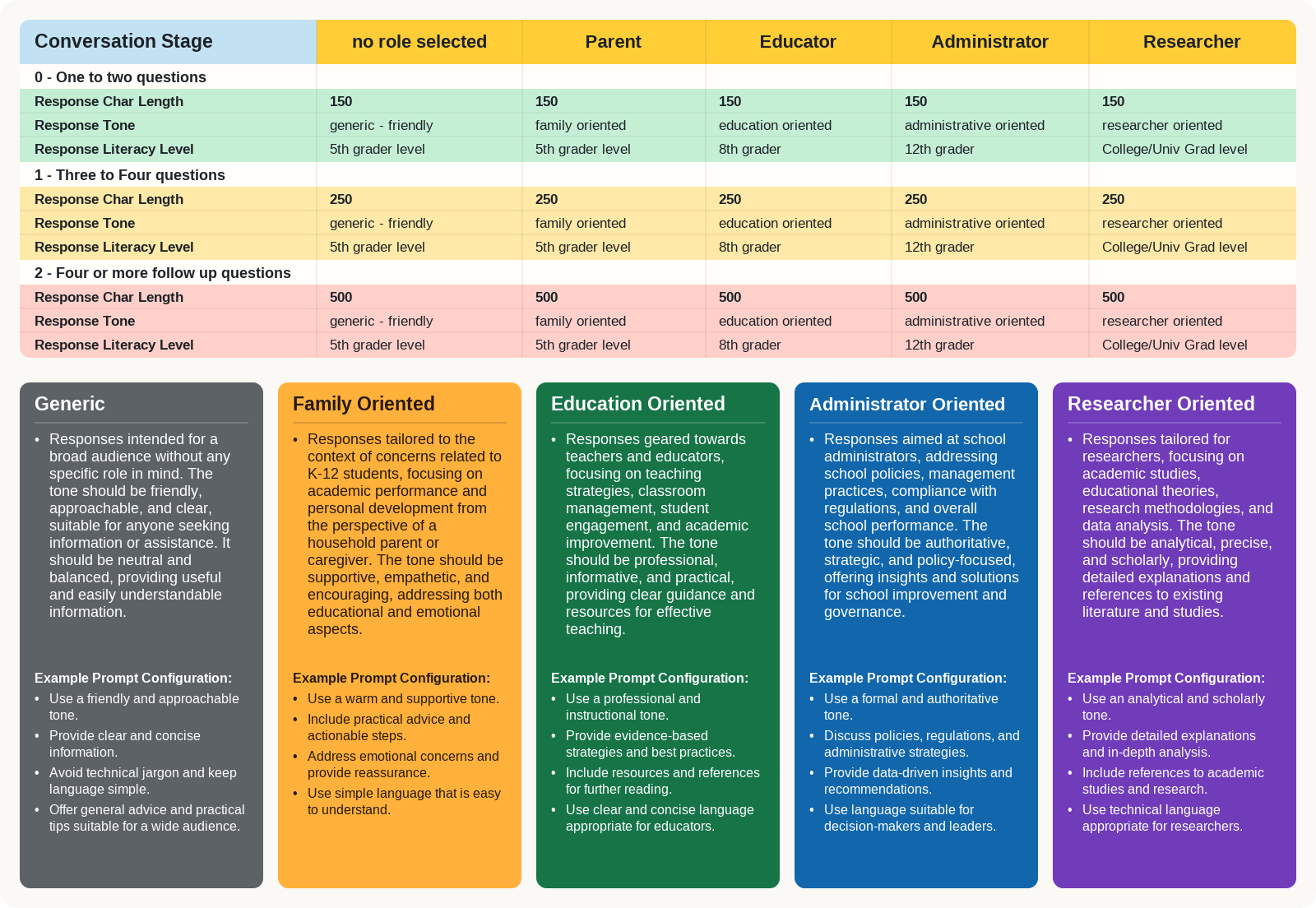
AskEd adapts tone and reading level to each audience. Replies start short, with follow-up options to go deeper.

Strategy definition

  1. First reply150 characters
  2. Follow-up250 characters
  3. Deeper questions500 characters

Swipe to compare all five audiences.

Conversation Stageno role selectedParentEducatorAdministratorResearcher
0 - One to two questions
Response Char Length150150150150150
Response Tonegeneric - friendlyfamily orientededucation orientedadministrative orientedresearcher oriented
Response Literacy Level5th grader level5th grader level8th grader12th graderCollege/Univ Grad level
1 - Three to Four questions
Response Char Length250250250250250
Response Tonegeneric - friendlyfamily orientededucation orientedadministrative orientedresearcher oriented
Response Literacy Level5th grader level5th grader level8th grader12th graderCollege/Univ Grad level
2 - Four or more follow up questions
Response Char Length500500500500500
Response Tonegeneric - friendlyfamily orientededucation orientedadministrative orientedresearcher oriented
Response Literacy Level5th grader level5th grader level8th grader12th graderCollege/Univ Grad level

Audience prompt configurations

Generic

Tone
generic - friendly
Reading level
5th grader level

Responses intended for a broad audience without any specific role in mind. The tone should be friendly, approachable, and clear, suitable for anyone seeking information or assistance. It should be neutral and balanced, providing useful and easily understandable information.

Example Prompt Configuration:
  • Use a friendly and approachable tone.
  • Provide clear and concise information.
  • Avoid technical jargon and keep language simple.
  • Offer general advice and practical tips suitable for a wide audience.

Family Oriented

Tone
family oriented
Reading level
5th grader level

Responses tailored to the context of concerns related to K-12 students, focusing on academic performance and personal development from the perspective of a household parent or caregiver. The tone should be supportive, empathetic, and encouraging, addressing both educational and emotional aspects.

Example Prompt Configuration:
  • Use a warm and supportive tone.
  • Include practical advice and actionable steps.
  • Address emotional concerns and provide reassurance.
  • Use simple language that is easy to understand.

Education Oriented

Tone
education oriented
Reading level
8th grader

Responses geared towards teachers and educators, focusing on teaching strategies, classroom management, student engagement, and academic improvement. The tone should be professional, informative, and practical, providing clear guidance and resources for effective teaching.

Example Prompt Configuration:
  • Use a professional and instructional tone.
  • Provide evidence-based strategies and best practices.
  • Include resources and references for further reading.
  • Use clear and concise language appropriate for educators.

Administrator Oriented

Tone
administrative oriented
Reading level
12th grader

Responses aimed at school administrators, addressing school policies, management practices, compliance with regulations, and overall school performance. The tone should be authoritative, strategic, and policy-focused, offering insights and solutions for school improvement and governance.

Example Prompt Configuration:
  • Use a formal and authoritative tone.
  • Discuss policies, regulations, and administrative strategies.
  • Provide data-driven insights and recommendations.
  • Use language suitable for decision-makers and leaders.

Researcher Oriented

Tone
researcher oriented
Reading level
College/Univ Grad level

Responses tailored for researchers, focusing on academic studies, educational theories, research methodologies, and data analysis. The tone should be analytical, precise, and scholarly, providing detailed explanations and references to existing literature and studies.

Example Prompt Configuration:
  • Use an analytical and scholarly tone.
  • Provide detailed explanations and in-depth analysis.
  • Include references to academic studies and research.
  • Use technical language appropriate for researchers.

View the full strategy (SVG)

Interface design

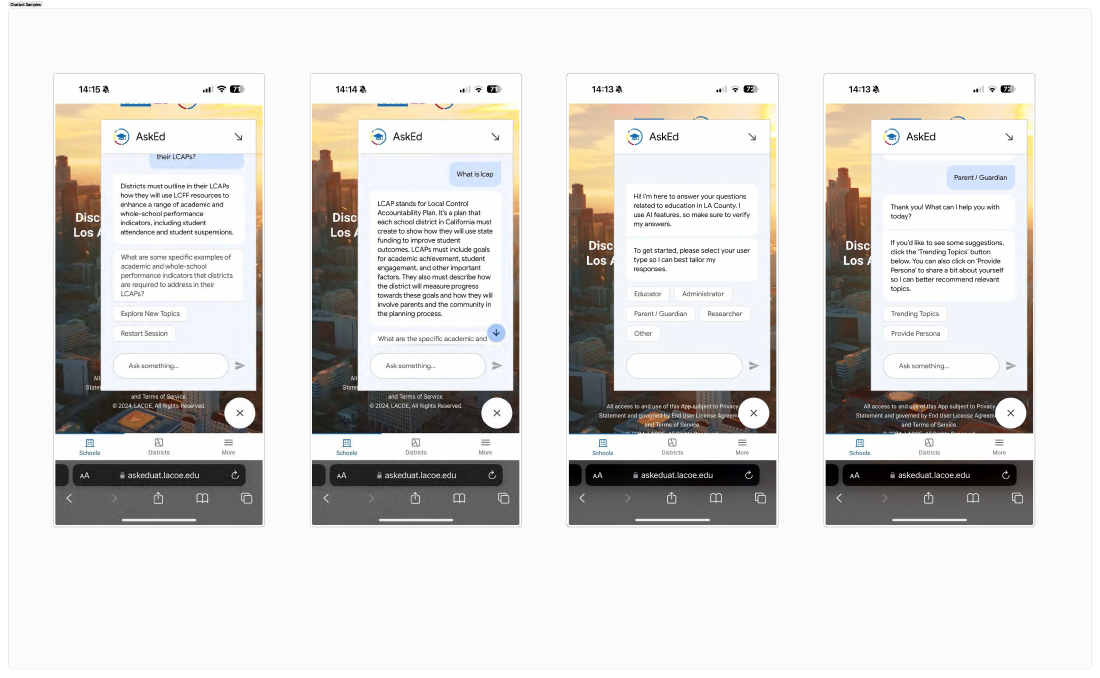
Four moments from the mobile experience, from selecting a role to following up on a school district’s accountability plan.

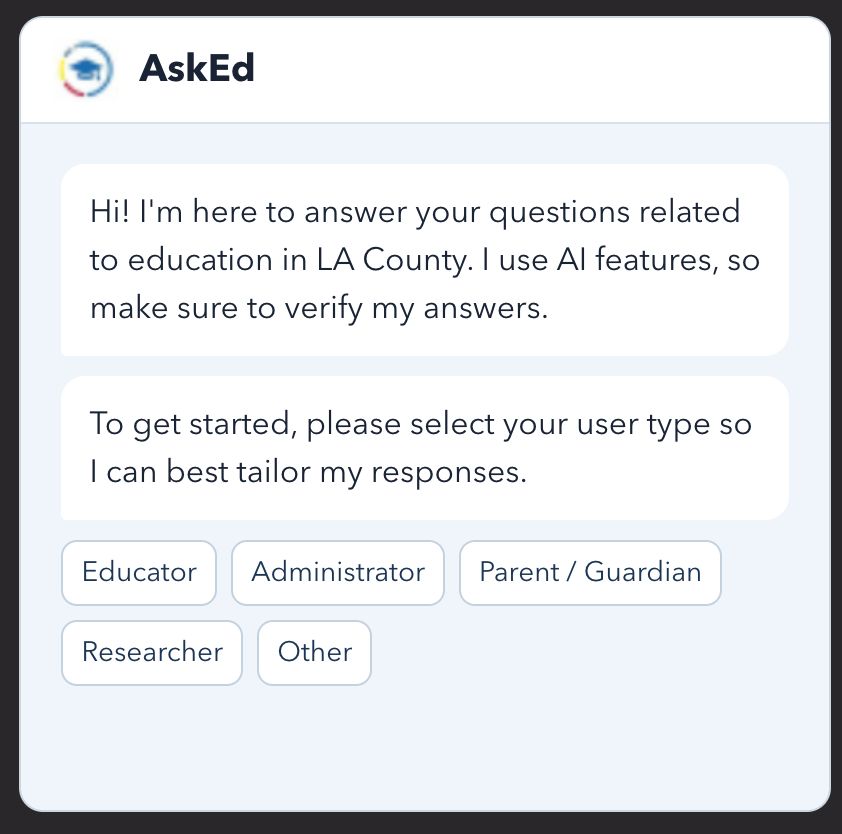
01 Choose an audience

AskEd

Hi! I'm here to answer your questions related to education in LA County. I use AI features, so make sure to verify my answers.

To get started, please select your user type so I can best tailor my responses.

  • Educator
  • Administrator
  • Parent / Guardian
  • Researcher
  • Other

02 Get a tailored welcome

AskEd

Visitor: Parent / Guardian

Thank you! What can I help you with today?

If you'd like to see some suggestions, click the ‘Trending Topics’ button below. You can also click on ‘Provide Persona’ to share a bit about yourself so I can better recommend relevant topics.

  • Trending Topics
  • Provide Persona

03 Ask a question

AskEd

Visitor: What is lcap

LCAP stands for Local Control Accountability Plan. It's a plan that each school district in California must create to show how they will use state funding to improve student outcomes. LCAPs must include goals for academic achievement, student engagement, and other important factors. They also must describe how the district will measure progress towards these goals and how they will involve parents and the community in the planning process.

What are the specific academic and…

04 Go deeper

AskEd

Visitor: …their LCAPs?

Districts must outline in their LCAPs how they will use LCFF resources to enhance a range of academic and whole-school performance indicators, including student attendance and student suspensions.

What are some specific examples of academic and whole-school performance indicators that districts are required to address in their LCAPs?

  • Explore New Topics
  • Restart Session

View the original interface

Design an assistant around the people who use it.